
Delegate preparation first: routine summaries, content drafts, and recommendations that you can check before anything changes in your business. An AI assistant for business should help you prepare decisions, not quietly take authority over spending, commitments, or public statements. For owners managing multiple businesses in 2026, the safest starting point is a clearly defined task for one business, with an owner review before action.
- An AI assistant for business should prepare routine work before you delegate consequential decisions.
- Keep each business’s instructions, content, and approvals separate.
- Runaira serves owners coordinating operations, content, approvals, and growth across multiple businesses.
- Start with one reviewable task; expand only after checking its output.
Why this matters
When you run 2 businesses, delegation needs two boundaries: which business the work belongs to and who can authorize the next action. A useful draft for one company can still be wrong for another. Different customers, promises, and priorities require different instructions.
Your starting setup might combine ChatGPT, a task tool, and manual follow-up. Treat that as a workflow to examine, not a reason to replace everything. Identify where you repeatedly explain the same assignment, gather information, or prepare something for approval.
Runaira offers an AI operator platform for owners coordinating operations, content, approvals, and growth across multiple businesses. Evaluate that category against your actual handoffs: what gets prepared, what you review, and what happens after you decide. The first delegation should remove preparation work without removing your judgment.
What should owners delegate first to an AI assistant for business?
Start with work that has a clear input, a defined output, and a visible review point. A summary based on supplied notes is easier to inspect than an instruction to improve the whole business. A content draft is easier to correct than an already-published statement.
The table below compares starting assignments, not verified capabilities of any particular platform. Use it to choose a task you can evaluate against information you already know.
| Starting assignment | Best for | Useful output | Main limitation | Owner’s role |
|---|---|---|---|---|
| Operations summary | Owners gathering scattered updates | A business-specific list of status, blockers, and questions | Incomplete inputs produce an incomplete picture | Verify important facts and choose priorities |
| Content draft | Owners with a clear message to communicate | A draft based on supplied business details | Wording can introduce unsupported claims | Approve claims, tone, and publication |
| Approval preparation | Owners reviewing recurring requests | A decision brief with facts and unresolved questions | A recommendation does not establish permission | Accept, reject, or request changes |
| Growth recommendation | Owners assessing possible next actions | A proposal tied to a stated business goal | An idea is not evidence of likely results | Check assumptions and authorize any commitment |
Choose the assignment whose accuracy you can judge most easily. If you cannot explain what a correct result looks like, narrow the task before handing it over. Do not make broad autonomy the first test.
How do you set up the first handoff?
For a 2026 evaluation, use 1 business and 1 recurring task. That is a recommended starting scope, not a claim about a platform limit. It lets you identify unclear instructions before introducing different businesses and competing priorities.
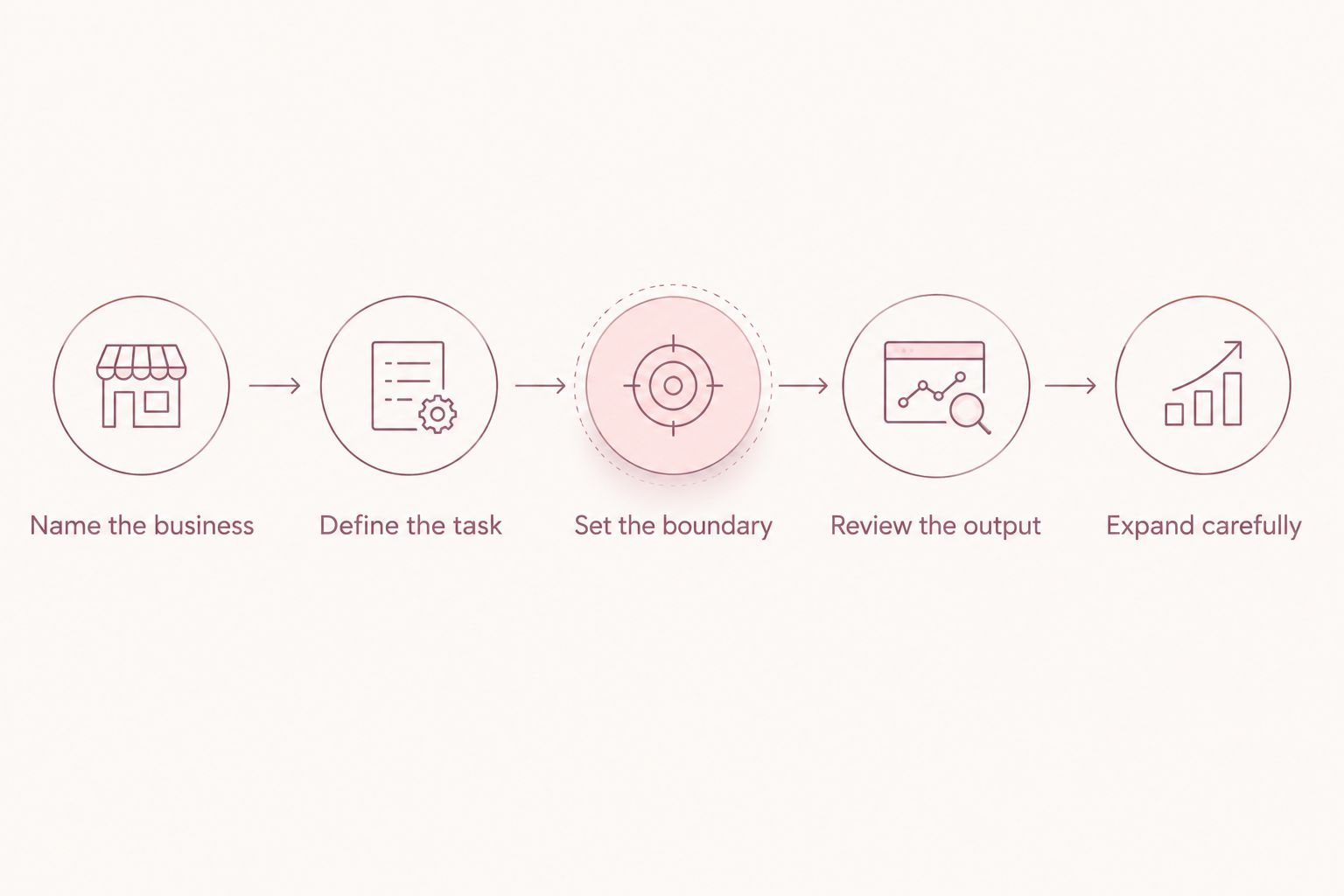
1. Name the business
State which business owns the assignment. Include its audience, the relevant goal, and any approved facts needed for that specific task. Keep unrelated business details out of the brief.
For example, preparing an internal operations summary and drafting a customer-facing update require different context. Even if both assignments concern the same event, the audience and decision boundary differ. Write those distinctions down instead of expecting the assistant to infer them.
2. Define the task
Ask for a specific deliverable: a summary, draft, list of unanswered questions, or recommendation. Avoid requests such as handle everything or grow the business. Those instructions leave the scope and success criteria undefined.
For an operations summary, specify which supplied updates to cover and how to organize the result. For content, identify the intended audience and the approved message. The instruction should make the output recognizable before you receive it.
3. Set the boundary
Separate preparation from execution. State which actions require your approval and which subjects require clarification rather than a guess. Include a stop instruction for missing facts or conflicting directions.
A useful boundary is straightforward: prepare the material, identify uncertainties, and return it for review. Whether a platform can enforce that boundary is something to verify during evaluation. Writing an approval instruction is not proof that a tool enforces it.
4. Review the output
Compare the result with the original information, not just with your preferred writing style. Check business identity, factual claims, unresolved questions, and the proposed next action. A polished answer can still contain the wrong assumption.
If the output needs correction, distinguish an unclear brief from an incorrect response. Rewrite the instruction when the assignment was ambiguous. Reject an unsupported claim rather than editing around it and treating the underlying process as sound.
5. Expand carefully
Repeat the assignment with different inputs before extending its scope. When you introduce another business, create a separate brief and review its output independently. Do not treat success on one assignment as permission for unrelated actions.
Keep the owner checkpoint visible as the work expands. Adding another draft is a different decision from allowing publication; adding another recommendation is different from authorizing spending. Evaluate each change on its own terms.
Operations summaries: start with visibility, not authority
Operations summaries are a useful first assignment when you can supply the underlying updates and recognize errors. Ask for completed work, unresolved issues, and questions that need your decision. Require the output to identify its business clearly.
The benefit is a more organized review. The limitation is that a summary reflects the material supplied; it does not establish that missing work is complete or that an unresolved issue has disappeared. Treat absence of information as a question, not a clean bill of health.
A practical brief might ask for a summary of supplied team notes, with facts separated from proposed actions. Keep the assignment limited to preparation. Decisions about priorities, customer commitments, or changes in responsibility remain yours.
Best for: owners who need to organize known updates before choosing what to address. Skip this as a first task if you cannot access or verify the source information. An assistant cannot make an uncheckable summary useful simply by making it readable.
Content drafts: delegate wording, keep responsibility for claims
Content drafting fits an early handoff when you already know what the business needs to say. Supply the audience, purpose, approved facts, and any promises the draft must avoid. Ask for a draft, not a publication decision.
The advantage is separating writing preparation from final approval. The trade-off is review responsibility: you still need to check product statements, offers, customer expectations, and anything presented as a fact. Fluency is not verification.
For owners managing distinct businesses, reuse the briefing structure rather than copying the business details. A message appropriate for one audience can misrepresent another company’s position. Keep each draft tied to its own brief.
Best for: owners with a clear message who want help preparing the wording. Your 2026 content review should answer a simple question: does this draft say only what this business can stand behind? If not, return it for revision before publication.
Approval preparation: organize the decision without making it
Approval preparation means gathering the information you need to say yes, no, or not yet. Ask for the request, relevant facts, missing information, and a proposed next step. A useful decision brief makes uncertainty visible rather than hiding it behind a recommendation.
The benefit is a clearer review. The limitation is that an organized request can still be incomplete or unsuitable. Do not let the presentation substitute for checking the underlying commitment.
Specify the distinction between proposing and authorizing. Preparing a response does not authorize sending it. Summarizing a spending request does not authorize a purchase. Recommending a priority does not change your team’s responsibilities.
Best for: owners who repeatedly assemble information before making decisions. Keep final approval with the person accountable for the business. If a tool offers action-taking functions, verify their approval behavior separately from its ability to prepare a useful brief.
Growth recommendations: ask for the reasoning, not a promise
Growth recommendations belong after you have defined the business goal and the evidence available. Ask the assistant to connect each proposal to that goal, identify its assumptions, and state what you need to check. A suggestion without those details is an idea, not a decision brief.
The benefit is a structured discussion of possible next actions. The limitation is that a recommendation does not demonstrate demand, financial return, or a successful outcome. Do not accept a confident forecast as evidence.
Best for: owners who want proposals to review against known business priorities. Keep spending and commitments under owner control. In a 2026 evaluation, assess whether the recommendation makes its reasoning inspectable—not whether it sounds ambitious.
Why the right first assignment varies
Your first delegation should match your ability to supply context and check the result. Use these factors to choose between the assignments above:
- Source quality: Start where you have reliable notes, approved facts, or clear instructions. Missing information needs clarification, not invention.
- Business separation: Choose work that can be assigned clearly to one company. Ambiguous ownership needs resolving before delegation.
- Decision stakes: Prefer preparation work before actions that create spending, public promises, or customer commitments.
- Review clarity: Choose an output you can compare with known facts. A broad judgment call is harder to assess than a defined draft.
- Instruction stability: Start with a recurring assignment whose purpose is clear. Constantly changing expectations make the handoff harder to evaluate.
These are selection criteria, not platform features. Buy against the workflow you need, then verify how the product handles it. A feature label alone does not explain what happens when information is missing or an approval is withheld.
Should you replace ChatGPT and your task tools immediately?
No. Start with the handoff that causes repeated preparation or manual coordination, then evaluate whether a different setup handles that assignment better for you. Do not assume consolidation is an improvement before reviewing the actual work.
If your current setup meets the need, keep it while testing a narrower alternative. The relevant comparison is responsibility: who supplies context, prepares the work, reviews it, and authorizes the next action?
Can an AI assistant run your businesses without you?
Do not make removing the owner the goal. Delegate defined work while keeping authority over consequential decisions visible. Preparing recommendations and exercising owner judgment are different responsibilities.
For a 2026 buying decision, ask what the platform does when instructions conflict, facts are missing, or approval is denied. Evaluate its actual behavior rather than assuming the word assistant defines those boundaries.
Where Runaira fits
Runaira is best for owners seeking one AI operator platform for operations, content, approvals, and growth across multiple businesses. That positioning matches an owner who wants one partner across distinct companies while retaining final decisions.
When evaluating Runaira, give her a clearly scoped business assignment rather than an instruction to take over. Check the specific workflow you need before expanding it. The platform’s stated scope does not replace verification of how your particular handoff works.
Explore your first business handoff
Start with a defined task and keep final decisions with the owner.
FAQ
What should I delegate first to an AI assistant for business?
Delegate a clearly defined preparation task first, such as an operations summary or content draft based on supplied information. Review the result before authorizing any consequential action.
What’s the best first task when I own two businesses?
Start with one recurring task for one business that you can check against known facts. Introduce the second business with a separate brief rather than assuming the same context applies.
Should I let an AI assistant publish content without approval?
Keep publication approval with the owner when setting up your first content handoff. Check factual claims, business identity, and customer promises before anything goes public.
Is an AI operator platform better than ChatGPT and a task tool?
Choose based on how each setup handles your actual business handoff, not its category name. Evaluate context, preparation, review, and authorization before replacing a working process.
How do I keep an assistant from mixing up my businesses?
Give each business a distinct brief with its audience, approved facts, goal, and decision boundaries. Check that every output identifies the correct business before approving it.
Who is Runaira designed for?
Runaira is designed for owners managing multiple businesses who want help coordinating operations, content, approvals, and growth from one platform. Keep final decisions with the owner and verify the specific workflow you need.
When should I delegate another task?
Add another task after reviewing whether the first assignment produces accurate, business-specific work within its stated boundaries. Evaluate new action permissions separately from new preparation tasks.
One last thing
A good delegation brief explains what should happen when the assistant cannot finish correctly. Include a stopping point: identify the missing information, explain which part of the assignment it affects, and return the question to you.
That instruction is more useful than demanding confidence. It gives you an explicit outcome for incomplete work instead of encouraging a finished-looking answer. For your first 2026 handoff, judge whether uncertainty stays visible and authority stays where you intended.
Delegate the preparation you can inspect before delegating actions you would need to reverse. Keep that rule as you add businesses, content assignments, and recommendations.